
Prefer to watch or listen instead of read?
Sometimes a story breaks in the news,
and women feel its reverberations in ways that are hard to explain.
It's like a ripple in the water.
A gust of wind.
A tiny shake beneath our feet.
Something unsettling in the air, a one-degree drop in temperature.
Nothing we can quite point to, but something has shifted.
We go to work.
We make dinner.
We answer our texts.
We carry on with our lives.
But something feels different.
Like, a low-grade fear fever.
An unspoken reminder that the world isn't always safe,
that danger doesn't always announce itself,
and that letting our guard down can feel like a risk we're not sure we can afford.
We don't all have the same algorithm.
We don't all follow the same news,
and we don't all have the same experiences or reactions to the stories that reach us.
But when stories of sexual violence—like what happened to Jane Doe at Cornell University—enter the public consciousness, many women recognize something in themselves that feels deeply personal. And it does something to a body—to a nervous system.
It may stir up something that happened to us.
Or something similar that happened to our sister.
Or something that almost happened to our best friend.
Or it may simply remind us that we live in a world where something like this is always possible.
And then, we get to watch the world discuss it.
We watch people debate whether the person who was harmed is telling the truth.
We watch their choices, their behavior, their credibility, their character get picked apart.
We hear the questions about what they were wearing, why they were there, why they trusted someone, why they didn't leave, why they didn't speak up sooner.
The harm itself is frightening enough. But the possibility of being disbelieved, scrutinized, or blamed afterward adds another layer of threat.
For many women, stories like these don't arrive in an otherwise uncomplicated understanding of the world. They land on top of years of small calculations.
The keys held between our fingers.
The text sent when we get home.
The assessment of a man's behavior.
The monitoring of the tension in a room.
The decision about whether a situation feels safe enough to relax into.
Much of this happens so automatically that we barely register it as vigilance at all.
We call it being “sensible.”
We call it being “careful.”
We call it being a woman.
And then a story like this arrives, and we are reminded why we've been paying attention all along.
It can reinforce the sense that our vigilance is necessary. That our anxiety makes sense. That letting our guard down might be dangerous.
Psychologists use the term hypervigilance to describe a heightened state of alertness to potential danger that exceeds “normal” watchfulness. It can occur in response to trauma and reminders of violence can leave us feeling more watchful, unsettled, or reluctant to let our guard down.
Our brains learn from what happens to us.
They also learn from what we witness, what we hear about, and what we come to understand about the world.
When someone else's experience reminds us of a danger we recognize, that threat can begin to feel closer.
Not because the event is happening to us, but because we understand that something like it could.
For women who have spent years learning to anticipate danger, sometimes the reminder isn't new information.
It's confirmation of an old fear.
And for some of us, it may bring our own experiences closer to the surface.
A memory we'd rather not revisit.
A feeling we thought we'd worked through.
A familiar sense of helplessness, shame, or fear.
This is one reason trauma can be complicated. Sometimes, an experience is over, but reminders of it can still bring up distress in the present. Our reactions don't always arrive with a clear explanation. We might simply notice that we're more anxious, more guarded, or less comfortable in situations that once felt ordinary.
Not every difficult reaction to the news is trauma, and not every reminder will affect us in the same way. But we can make room for the possibility that what we witness, and what it brings up for us, matters.
And we don't have to wait until we're falling apart to take that seriously.
When the next story breaks
And anyone paying attention knows there will be another.
Something may shift inside us. Our nervous systems are constantly taking in information about safety and danger. Sometimes that information calls for action. Sometimes a reminder of danger activates a protective response even when we aren't in immediate danger ourselves.
The question isn't whether we should feel something. Of course we feel something. Sexual violence is awful, and learning about it can be frightening.
The question is how we care for ourselves when the fear is real,
but the danger isn't necessarily happening here, now, to us.
We don't have to convince ourselves that the world is safe—because it isn’t—in order to respond compassionately to the fact that it feels frightening.
We can acknowledge the fear without treating it as proof that something terrible is about to happen.
We can recognize that a story has stirred something up without demanding that we immediately get over it.
And we can remember that our feelings don't need to be justified before they deserve our attention.
When we acknowledge our emotional experience rather than fighting it, we may create a little more room around it. The fear doesn't have to disappear. The sadness doesn't have to resolve. But we no longer have to contend with the additional pain of telling ourselves that we shouldn't feel this way.
How we feel matters, even when we can't immediately make it feel better.
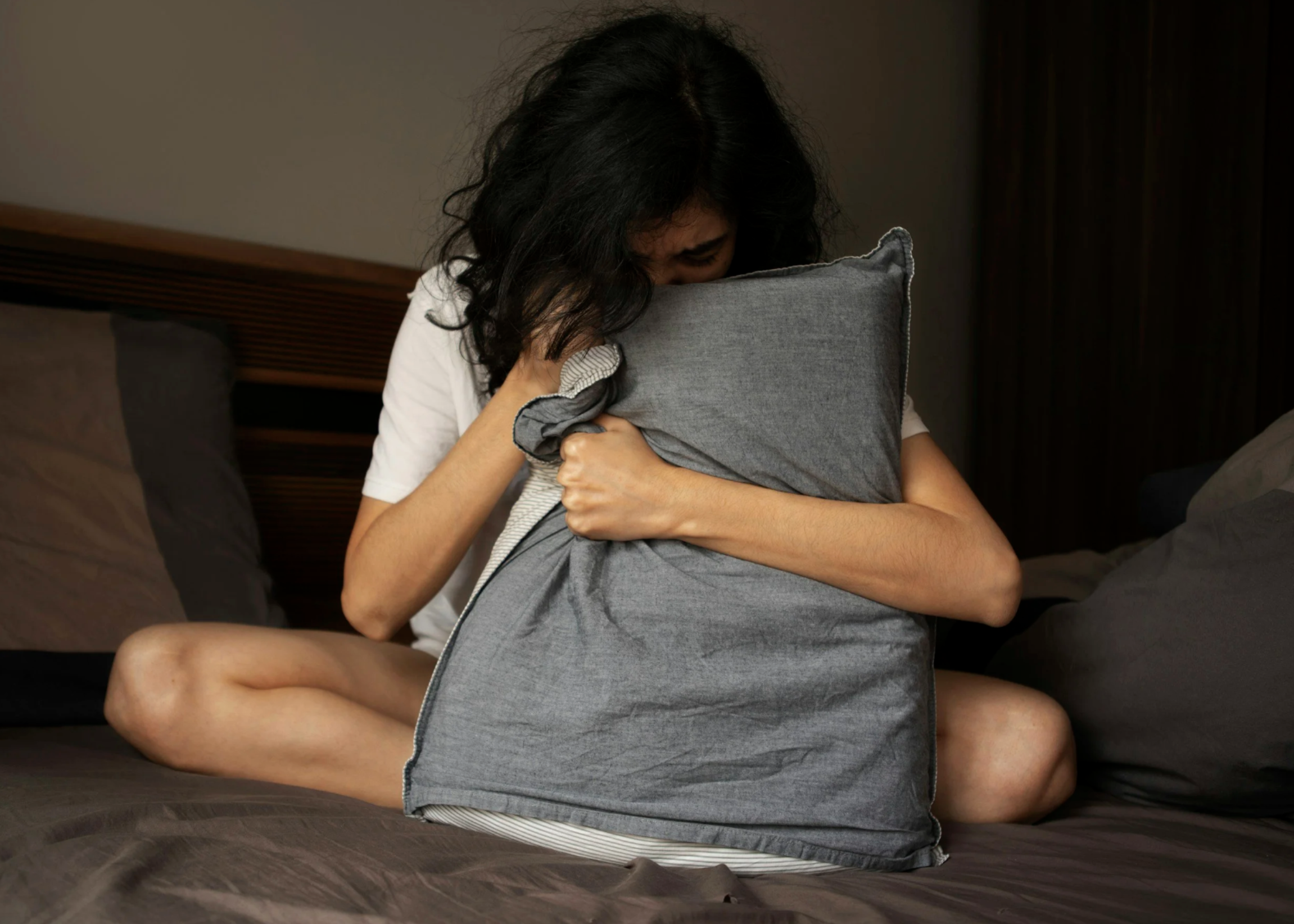
Mindful Self-Compassion Break
When I help clients navigate distress, one practice I sometimes borrow from Dr. Kristin Neff's work on self-compassion work is the self-compassion break. It's a simple way to meet a painful moment with a little less judgment and a little more kindness.
You might try it yourself.
1. Offer yourself some comfort.
If it feels good, place a hand over your heart, wrap your arms around yourself, or settle into a blanket. You might also soften your posture or simply take a moment to notice the support beneath you.
2. Name what you're feeling.
Can you put a word to it? Fear? Sadness? Anger? Despair?
Try saying to yourself, This is a temporary moment of ______.
Not to minimize what you're feeling, but to acknowledge it and its place as a temporary experience.
3. Remember that you're not alone.
You might say, I'm not alone in being frightened or heartbroken by the world. Other people feel this too.
This doesn't make the pain smaller or less important. It reminds us that our response is part of our shared humanity.
4. Ask yourself what you need to hear.
What might you say to a friend who was carrying this same fear? Can you offer yourself even a little of that kindness?
Perhaps it's: I can be gentle with myself, even when I'm scared.
Or: I don't have to talk myself out of my pain to take care of myself.
Or simply: This is hard, and I deserve care, too.
When the past comes into the present
Sometimes, our reactions to stories of violence reach beyond the story itself. They connect with experiences we've lived through, things we've witnessed, or memories that still carry a great deal of distress.
When that happens, self-compassion can be an important starting point. And sometimes, we need more support in working through what has been stirred up.
In my practice, I use EMDR therapy to help people process distressing experiences and memories that continue to affect their lives. Sometimes, a past experience remains emotionally charged, and reminders can bring back the fear, helplessness, or bodily alarm associated with it. EMDR therapy can help reduce the intensity of those reactions so that a person can remember what happened without experiencing the same level of distress in the present.
It isn't about convincing ourselves that the world is harmless.
It isn't about becoming less perceptive, less discerning, or less aware of injustice.
It's about making room for the present, rather than having every painful experience continue to demand our attention as though it were happening now.
We may not be able to control what stories reach us, what other people do, or what the world asks us to witness. But we can learn to recognize when something has been stirred up inside us, seek support when the fear feels bigger than we can manage alone, and respond to ourselves with care rather than criticism.
The scared part of us doesn't have to justify its feelings to the logical part.
The grieving part doesn't have to prove that the world is terrible enough to deserve our sadness.
And the part that wants to keep living, loving, laughing, and enjoying things doesn't have to betray the part that knows how much suffering exists.
We can make room for all of them.
We don't have to resolve these contradictions to take care of ourselves. We can acknowledge that the world holds real danger without treating every frightening story as a prediction of our own future. We can honor our fear without letting it become the only voice we listen to. And we can remember that caring for ourselves doesn't mean looking away from what happens to others.
Most importantly, we can refuse the idea that the burden of preventing violence belongs to the people who might experience it.
Women should not have to be constantly hypervigilant to deserve safety.
We should not have to anticipate every danger, interpret every signal correctly, or take every possible precaution to earn the right to move through the world without fear.
We deserve safety even when we're not paying “perfect” attention.
We deserve to be believed when we speak about harm.
We deserve care when we're frightened, and compassion when we're struggling.
We don't have to become fearless to live meaningful lives.
We don't have to pretend terrible things don't happen.
And we don't have to shame ourselves for the ways we respond to a frightening world.
Fear need not be the price of admission for being a woman in the world.
When the next news story about sexual violence breaks and everyone wants to share their opinions and grievances
and something shifts inside of you, remember:
Let yourself feel how you feel without judgement
Get curious about what the story has stirred up for you
Meet that experience with all of the compassion you can muster
And surround yourself with as much comfort and safety as possible.
The world can be a frightening place.
But you deserve to feel at home in your own life.
Onward.
If you're looking for trauma therapy, EMDR therapy, or nervous system-informed counseling anywhere in Colorado via telehealth or in-person in Greeley, I'd be honored to support you. I work with generous women who tend to over-do-it and help them navigate burnout, overwhelm, and chronic self-pressure. Learn more about working together here.
Sign Up For A More Human Life Essays
If this writing resonated with you, and you’d like more opportunities to get meaningful content outside of a social media platform, I'd love to continue the conversation.
A More Human Life is my monthly letter where I'll share one thoughtful essay each month about healing, connection, and living a more human life. I’d be honored to have you join me by following this link, so you can receive future letters directly to your email inbox.
