
Self-Possessed: Why Having a Self Isn’t the Same as Being Selfish
Prefer to watch or listen instead of read?
self·ish
/ˈselfiSH/
adjective
(of a person, action, or motive) lacking consideration for others; concerned chiefly with one's own personal profit or pleasure.
It's just an adjective.
A description of behavior.
Not a personality type.
Not a medical diagnosis.
Not an objective measurement.
"Selfish" is a judgment we make about behavior—and those judgments depend on who is doing the judging.
In my clinical work, I am shocked by how often I hear women call themselves "selfish."
Or make decisions to avoid appearing "selfish."
Or organize their entire lives around whether something might be perceived as "selfish."
As if “selfishness” is an objective line that everyone can see.
A thing we can measure.
A thing we all agree upon.
It isn't.
And yet, this fear quietly drives an astonishing amount of behavior.
“Selfish” can be an invisible fence to keep women small
Many of the women I work with move through life as though there is an invisible fence around them. They instinctively know when they're getting close to "the line." The line where they've spoken too firmly. Asked for too much. Taken up too much space. Needed too much.
When I ask where that line actually is, they often look at me like I've asked what continent we live on.
It's obvious.
Isn't it?
Except...it isn't.
So let's talk about it.
There is something profoundly gendered about the way many girls are raised.
Somewhere along the way, many of us absorb a set of unwritten rules.
You can talk—but not too loudly.
You can dream—but not too big.
You can eat—but not too much.
You can play—but not for too long.
You can experience joy—but not at the expense of your responsibilities.
You can have needs—but never, ever let those needs inconvenience someone else.
Ever.
Eventually, many women become emotionally paralyzed.
If they aren't exactly sure where the line is, it feels safer to stay small than to risk crossing it.
And when there are no clear boundaries, we create invisible ones ourselves.
We have a dog named Captain.
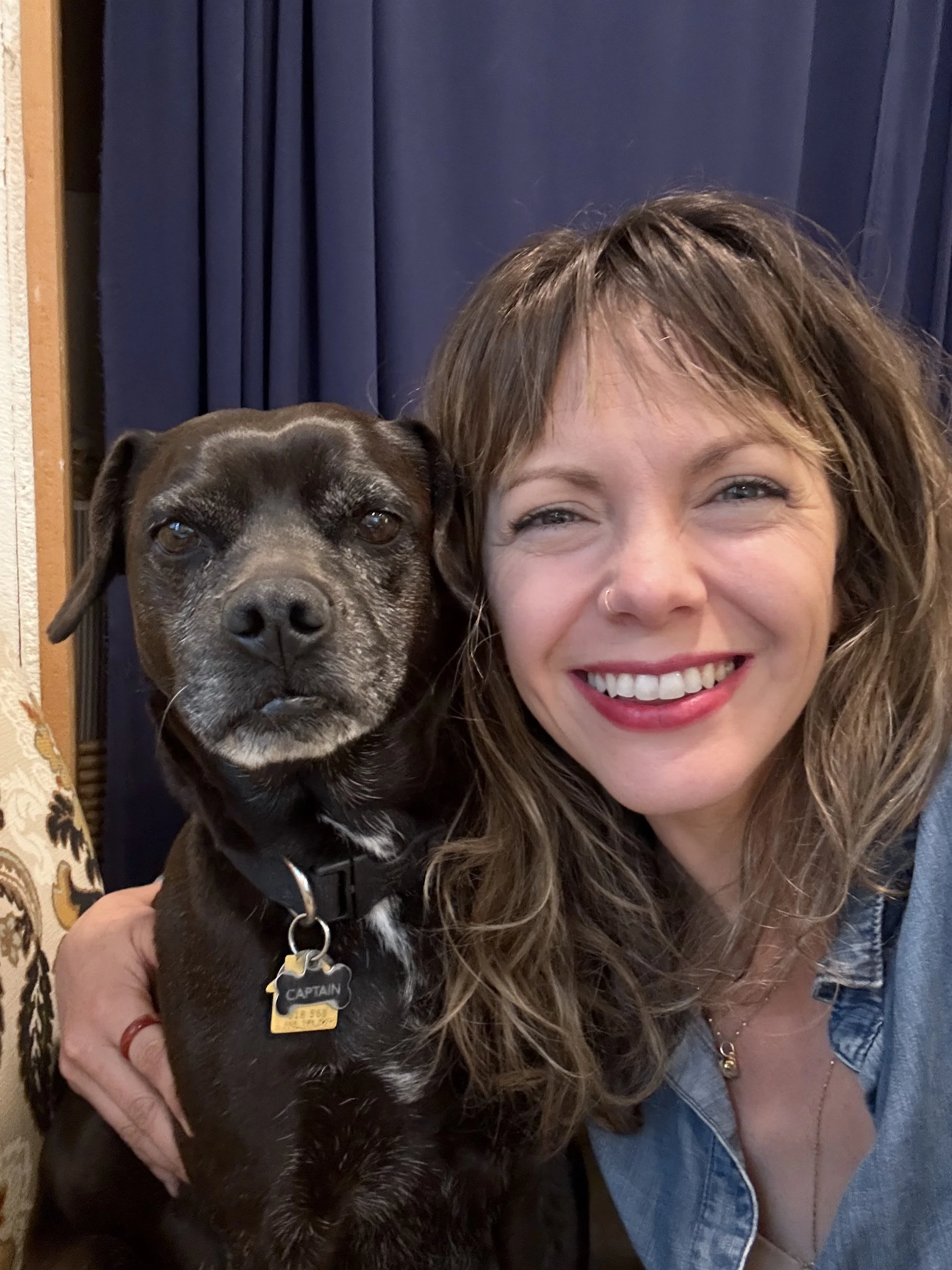
To keep him safe from the busy road near our house, we installed an invisible electric fence around our property. When Captain approaches the edge, his collar first vibrates, then beeps, and eventually delivers a mild shock.
Do you know how long it took him to learn where the boundary was?
About five minutes.
Five minutes to completely reorganize his behavior around the possibility of a consequence.
What's fascinating is that sometimes we forget to put the collar on him.
Sometimes the battery on the collar dies.
Sometimes the power goes out and the fence isn't working at all.
And where do we find Captain?
Standing comfortably inside the same invisible boundary.
The actual consequence is gone.
But the expectation of the consequence remains.
This is how I think about the fear of selfishness.
It's partly real.
Partly imagined.
Not because the social consequences are imaginary—they often aren't—but because the boundary itself is subjective.
It's a prediction of what might happen if we step out of line.
And predictions can shape behavior just as powerfully as reality.
Here's what saddens me:
This fear doesn't just make women uncomfortable.
It interferes with healthy psychological development.
Developmental psychologists have long observed that healthy adulthood requires us to become whole—to develop the parts of ourselves that our under developed and/or our upbringing neglected to reinforce within us.
For boys and men who are often raised to take up space and learn independence, their developmental work often involves considering the needs of a group and collaborating with others.
For girls and women who are often raised to take up less space and prioritize collaboration over independence, their developmental work tends to involve building a stronger sense of self instead of defining ourselves primarily through our relationships with others.
This might look like:
Finding our own voice.
Learning what we want.
Developing opinions.
Setting boundaries.
Tolerating disappointment.
Not because other people don't matter, but because you matter, too.
And that's why I grow weary every time I hear a woman describe herself as “selfish” simply because she's learning to occupy more space in her own life.
I think when many women say,
"I'm being selfish,"
what they actually mean is,
"I'm uncomfortable with the possibility that someone else might judge me for becoming a full person with wants, needs, preferences, and limits."
We are often confusing selfishness with personhood.
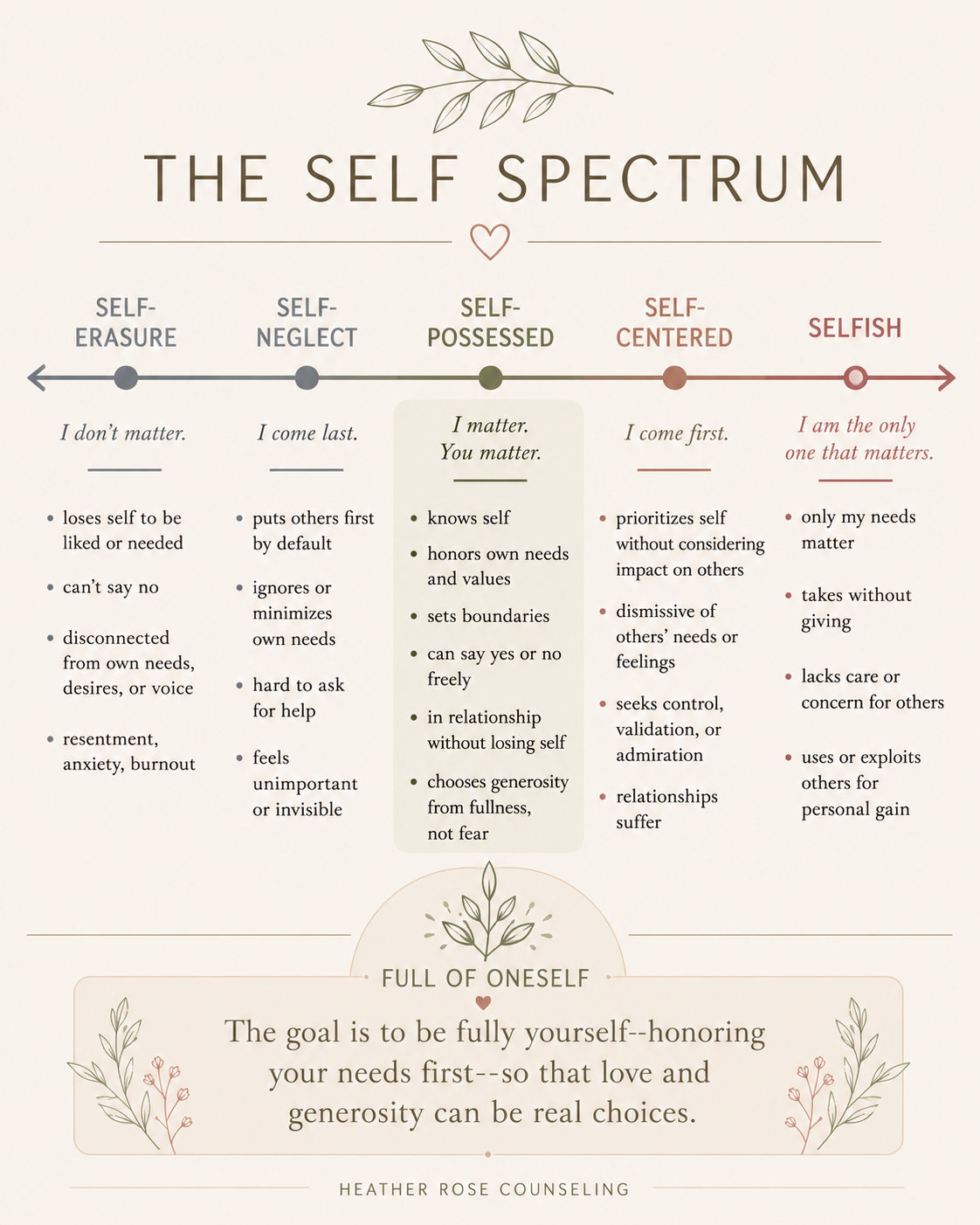
Here's the model I often think about when defining “how much Self” clients are allowed to have!
Imagine two people sitting in front of a pie.
There’s enough pie for both people two have half of the pie.
Selfishness isn't taking half.
Half is fair.
Selfishness might be taking three-quarters without asking, and assuming the other person should simply be grateful for what's left.
But many women I know take one-quarter. Or one-eighth.
Slide the rest across the table.
Then feel guilty because someone noticed them eating.
(Don't even get me started on diet culture.)
And let's be honest.
She probably bought the ingredients.
Baked the pie.
Remembered everyone's dietary preferences.
Served everyone else first.
And is still wondering whether taking one slice makes her look selfish.
We have got to change how we use this word.
Let's reserve "selfish" for what it actually describes:
Taking more than your fair share at the direct expense of someone else.
Perhaps becoming a healthy adult woman isn't learning to need less. Or even to be less selfish.
Maybe it’s about finally believing that you’re allowed to be full of yourself, filled up with your self-ness. Because from that place, of full self-possession, generosity becomes a whole-hearted choice instead of a culturally mandated obligation.
Generosity isn't generosity if it comes from fear.
It's only generosity when it comes from a self that is free to choose.
So the next time you're tempted to call yourself “selfish,”
pause for a moment.
Are you actually taking more than your fair share or are you just uncomfortable having needs?
Maybe one of these words is actually more accurate. Maybe instead of being “selfish,” what you are actually being is:
Self-considering.
Self-respecting.
Self-protective.
Self-directed.
Self-possessed.
Appropriately boundaried.
Honest about your capacity.
Reciprocal.
Fair.
Discerning.
Willing to disappoint others instead of yourself.
In possession of your own goddamn life.
Onward.
Sign Up For A More Human Life
If this essay resonated with you, and you’d like more opportunities to get meaningful content outside of a social media platform, I'd love to continue the conversation.
A More Human Life is my monthly letter where I'll share one thoughtful essay each month about healing, connection, and living a more human life. I’d be honored to have you join me by following this link, so you can receive future letters directly to your email inbox.
If you're looking for trauma therapy, EMDR therapy, or nervous system-informed counseling anywhere in Colorado via telehealth or in-person in Greeley, I'd be honored to support you. I work with generous women who tend to over-do-it and help them navigate burnout, overwhelm, and chronic self-pressure. Learn more about working together here.
