
Our Collective American Nervous System is in Crisis Mode (here’s what you can do)
“I’m scared for our country.”
“My family isn’t speaking to each other.”
“I’ve unfriended everyone who disagrees with me on social media.”
“I’m afraid to talk to my neighbors.”
“I bought a gun.”
These are some things I’ve heard in the therapy room in the last month. Nearly every other person comes to session and answers the question, “How are you?'“ with some version of: “I am not okay.”
I get it.
If you are not okay, please keep reading.
Because I need you to know that I see you.
I hear you.
And you are not alone.
Say it with me now: “I am not alone.”
(In fact, if you need a minute for yourself, I’d invite you to lay on the floor and stretch and breathe deeply and meditate on those words. Might I recommend this song/mantra by the same name. It’s on repeat in my house lately.)
Our collective American nervous system is in fight or flight.
Also known as sympathetic engagement.
Hyperarousal.
This state, rooted in the spinal cord, responds to cues of danger.
As stress and arousal increases, adrenaline is released and we are mobilized for action.
Fight/flight says: “Let’s goooo!”
Thank goodness that we have this genius nervous system response to protect us when things get hairy.
Fight/flight is meant to temporarily enable action during a crisis,
activate super-human strength,
muster endurance during an emergency,
and harness the energy we need to survive harrowing circumstances.
It is not built to be sustained long-term.
No amount of caffeine or sugar will allow a prolonged fight/flight response for longer than a few moments.
Fight/flight is meant to be a temporary nervous system place that we visit.
Not a permanent place that we live.
But with every news cycle, headline, Tik Tok video, Instagram story, bumper sticker, and extreme radio commentator, we are tempted and lured back into a heightened state of activation that we simply cannot carry. Any human that’s forced into (or opts into) a near-constant fight/flight state will eventually crumple into a freeze state.
Parasympathetic.
Dorsal Vagal.
Shut-down.
Collapse.
Overwhelm.
Freeze says: “I just can’t do this anymore.”
We freeze to survive.
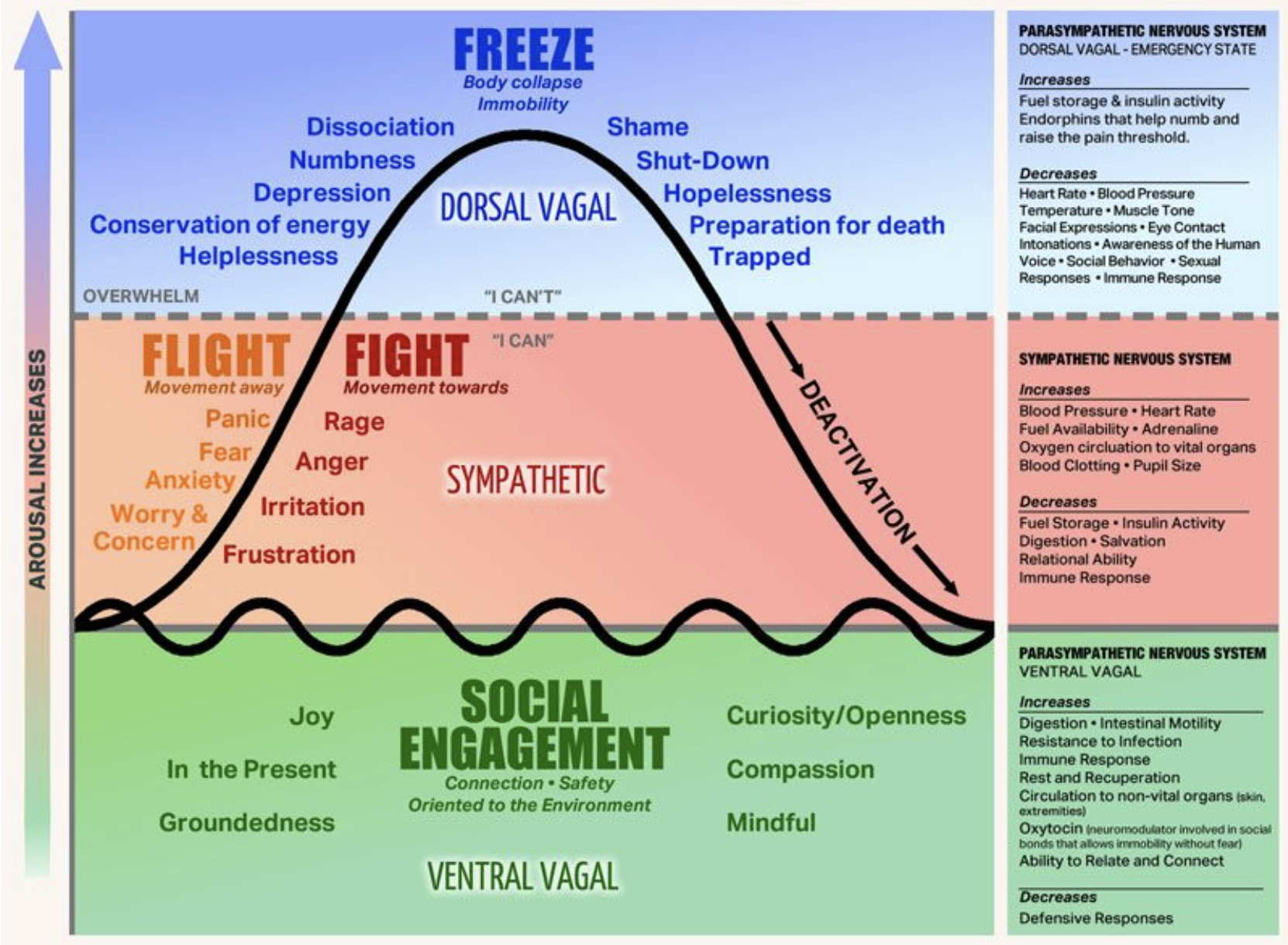
In fact, we can become so accustomed to the vacillation between fight/flight and freeze
again and again and again
that we begin to confuse a freeze state (numbness) with a safe state (peace).
We kid ourselves into thinking we’ve recovered from the stress
when actually we’ve just exhausted ourselves to the point of collapse and our bodies force shut down.
These United States of America—at large—seem to be existing in fight/flight with temporary visits to freeze.
But that isn’t working.
That isn’t serving us.
That is making us scared.
Hypervigilant.
Guarded.
Head-on-a-swivel.
Fearing the worst.
That is making us scared of our neighbors.
More likely to isolate and stay home.
Withdraw to our echo chambers.
Read the comments.
Simply survive and call it a “life.”
This is called nervous system dysregulation.
Dysregulation is not about visiting a flight or flight state.
It’s not about visiting a freeze state.
It’s about getting stuck in either state without adequate opportunity to heal and recover.
I want you to know that if any of this sounds familiar:
You are not broken.
There’s nothing wrong with you.
Your nervous system is responding exactly as it’s intended to.
It just needs a little help.
At best, humans thrive with a nervous system at peace (as often as possible).
Ventral vagal.
Grounded.
Joy.
Curiosity.
Openness.
Safety.
Rest.
Peace says, “In this moment, all is well.”
No one has the luxury of living in this state either.
Due to various factors such as age, race, gender, socioeconomic status, sexual orientation, disability, and more; easy access to peace and safety are not equally available to all of us. Some folks will have to protect themselves and recover from a dysregulated nervous system state more often than others.
So, let’s just remember: there is no such thing as constantly living in a “perfect” nervous system state.
That’s just not the world we live in.
However, the goal—as often as possible—is to be in a peaceful nervous system state with temporary visits to fight/flight (when necessary) and intentional practices to help us recover and find homeostasis again. The goal is have a regulated nervous system that can bend and flex, spike and recover, without getting stuck.
This is where your friendly, neighborhood therapist probably reminds you of things you already know, but might’ve fallen by the wayside.
Ask yourself these questions:
-What helps me feel as safe, secure, peaceful and regulated as possible (signs of safety)? Which environments, colors, temperatures, settings, textures, noise levels, relationships, people, behaviors/habits, hobbies, exercises, foods, TV stations, social media platforms, and podcasts bring me a sense of ease?
-What provokes a sense of fear, despair, anger, and dysregulation for me (signs of danger)? Which environments, colors, temperatures, settings, textures, noise levels, relationships, people, behaviors/habits, hobbies, exercises, foods, TV stations, social media platforms, and podcasts bring me a sense of panic?
-Get curious about when you might have to engage with situations that lead you to feel dysregulated. Do you really have to go there? Can you opt out? Will Aunt Sally be upset, but eventually get over it?
-If not, and you must engage with things that you know provoke dysregulation for yourself; plan accordingly. Consider how you might limit your exposure: time, frequency, duration, and proximity.
-And afterward, take good care. If/when you have decided to purposefully engage with things that tend to promote dysregulation for you (because you can’t quit your job right now or you can’t avoid all loud noises), pull from your list of signs of safety as soon as possible. Help your nervous system recover and find some version of peace and calm again.
This is not “ five easy steps to combat stress.”
This is not “one simple strategy to find inner-peace.”
Stress is a necessary part of life.
Feeling dysregulated (at times) is normal.
Feeling dysregulated as a way of life, is not normal.
Your body already knows where it feels safe/secure and where it doesn’t.
What if instead of fighting with your nervous system, you trust her.
Respect her.
Honor her.
Build a relationship that says, “When you’re scared and overwhelmed, I will take care of you. No matter what.”
Moving Toward a More Peaceful America
Being a better friend to your nervous system won’t single-handedly carry all of us through this painful season in America, but I believe it will help.
Because as Anais Nin wrote: “We don’t see the world as it is, we see it as we are.”
And so if you can see this world through the lens of a healthy nervous system, that can bend and flex and recover from the highs and lows of modern life, then that will help to carry you through.
And your well-being directly impacts mine.
And ours.
And collectively, when more of us are well, our country thrives.
Onward.
